
Micromobility in Lake County
By: Andy Davis
Infrastructure Improvements Could Lead to Better Access; Less Car Dependency
Micromobility can be defined as small, low-speed means of transportation that are used to transport persons/cargo/etc. over short distances. Examples include bikes, e-bikes, scooters, or even something as simple as walking. The associated vehicles are typically either man-powered or electric-powered, and do not rely on fossil fuels. Micromobility is tied to one of the most complex and cost-inefficient problems in transportation: the last mile problem.
The last mile problem is the dilemma of moving someone, or something, from a “central” hub or location to its final destination. Although the last mile is, typically, a very short distance comparative to the total logistical journey, the last mile can account for up to 53% of the total cost of the journey.
This is where micromobility, and the associated infrastructure, steps in and attempts to fill the gap. The idea is that, for the last mile, or whatever the distance of the remaining journey is, people are able to safely walk/bike/etc. to their destination after disembarking from a transit route. Micromobility, and the last mile problem, is why many of Laketran’s buses have bike racks. It’s why bus stops are typically connected to sidewalks. It’s why bike lanes and bike paths exist. This problem, and its associated solutions, are perfect to implement in Lake County, as the infrastructure already exists and is highly regarded among residents and visitors alike.
Bike Connectivity in Lake County
As mentioned in our previous article: Lessons That Lake County can Learn from World Cup Countries, Lake County already has 62 miles of bike lanes and paths. However, most of these miles come from the Lake Metroparks system, and the remaining bike lanes either do not connect to public transit, or aren’t safe enough to encourage widespread usage. In the case on the Lakeshore Blvd bike lanes in Mentor; nothing but a few-inch diameter of paint separates cyclists from the rest of the road. As a result, a singular distracted driver could prove fatal for any cyclist that attempts to traverse that bike lane. Also, these paths are usually only accessible via automobile and nothing else, which disallows for biking to be used as a true form of micromobility.
In fact, parks only being able to be accessed by automobile seems to be a common theme across Lake County. Between township parks, Metroparks and anything in between; these recreational spaces seem to have a very common theme: a lack of sidewalk access to neighboring communities.
Anecdotally, I live near Concord Township park, which is the township’s community center. It hosts concerts, an all-day fair in the summer, and includes a playground plus two softball/baseball fields. If I, or any of my neighbors, want to access this park that is under a mile away, we have two options. We can walk, which includes a stretch on a state route with no sidewalks or any sort of pedestrian infrastructure, or we can commute via automobile.
This prevents unlicensed individuals, or those without an available car at home, from being able to access this park without a car, at least without it being a dangerous journey. Something as simple as a new sidewalk on the side of the road would promote kids, teens, and anyone in the area to better access the park. Kids can walk up and play baseball with old or new buddies. Teenage babysitters can take kids on walks up to the playground. I can safely bike or walk up to Concord Community Day on Saturday instead of fighting for a parking spot. All made possible by one sidewalk.
And, in theory, it could promote the potential for a new bus route/stop to connect the center of Concord to wherever Laketran desires. Although that’s just a pipe dream at the moment, sidewalks pair perfectly with transit stops, and help solve the aforementioned “last mile problem.”
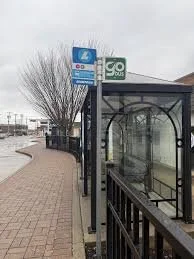
Sidewalk and Bus Stop Connections.
In case we haven’t made it clear in this article, sidewalks and public transit *should* go hand-in-hand. All transit stops should be accessible via a network of sidewalks, not just a few pieces of concrete to mark the stop’s area. However, this is not the case everywhere in Lake County.
We mentioned Lakeshore Blvd’s bike lanes earlier, and we’re going to put that stretch of road on blast, yet again. Route 8 Between Mentor-on-the-Lake and Mentor follows that same stretch of Lakeshore Blvd, with many stops being situated in front of neighborhoods. Despite this, the bus stops are marked by a typical sign and… grass. No sidewalk connecting the stops to associated neighborhoods. No sidewalk running adjacent to Lakeshore. Nothing other than the aforementioned bike lanes, which are already not protected.
For an example of a successfully connected transit stop, we can see the Painesville Transit Center to the right, and how it does well with connecting the bus hub to the rest of the city with a wide sidewalk that connects via a sidewalk network. On top of that, the stop has numerous stop shelters, decent signage, and an area for buses to idle. This allows for a safe, accessible, and easy-to-use stop, which promotes ridership attraction and accessibility.
Why does Micromobility Matter?
Micromobility does everything that trains, buses, and cars fail at. It connects people to their final destinations in a fast, easy fashion, while providing increased safety for all its users. Whether its walking or commuting via bike (or segway, Paul Blart: Mall Cop style), micromobility benefits all that use it, while increasing transit access and ridership. It offers a great solution to the last mile problem, while simultaneously promoting a healthy lifestyle.
The Next Steps for Lake County
In its current state, Lake County is full of “stroads” (think Routes 20, 44, 615, 306, and 91, for example). Stroads are wide, higher-speed roads that aim to connect both local destinations and longer routes via the automobile. They’re often packed with traffic and full of accidents due to the higher-speed nature. For pedestrians, stroads are considered unnavigable even if there’s a sidewalk. Cars zoom past at high speeds and large parking lots separating businesses from any pedestrian or transit access.
However, stroads offer a blank canvas for micromobility. These roads can easily be upgraded and rebuilt to include bike lanes, bus lanes, wider sidewalks, etc. Currently, Vine Street is undergoing a similar transformation to better connect Willoughby, Eastlake, and Willowick in a multimodal fashion. Bike lanes and bus shelter upgrades are coming to the 4-lane stroad, as well as streetscape changes. According to the engineering consulting firm tasked with developing this project, CT Consultants, a similar project in Franklin, TN “saw investments soar, vacancy rates dropping from 35% to 5%, а 28% increase in new business, and rents/sq. ft. that rose by an average factor of 10” according to a letter to the Mayor of the City of Eastlake.
With this project under construction, and the potential success for many businesses along the streetscape nearing, it’s possible that other cities in Lake County could and should follow suit, if they’re not already. Micromobility encourages connections to our communities, and Lake County has the potential to be a micromobility and transit haven.
