
Regional Rail to Lake County?
By: Andy Davis
Regional Rail to Reconnect the Past, While Building for the Future
Lake County, like many of the collar counties around bustling cities in the United States, ditched one of the most robust and connected passenger rail systems in the world for the personal automobile in the mid-to-late 20th century. This shift was due to phenomena such as white flight, suburbanization, and automotive lobbies in our government. All of these factors have built car-dependency to be the status quo in our great region, which has stripped both urban and rural communities of life and economic activity, all while raising the costs of living, and sprawling residents into individualism.
The “freedom of transport“ that the personal automobile promises has come at a hefty price, which is paid for by the good, hardworking people of our country. Downtown fabrics have been demolished for parking, highways, and wide roads. Tariffs, foreign conflicts, and other political factors have raised the costs of automobiles and the fuel needed to use them. Lake County’s hardworking citizens are getting price-gouged by the depreciating assets that sit in their driveways and their associated fuel prices. It’s time for a better form of transportation, one that promotes the pillars of a connected community: sustainability, equity, and development for the people: A Regional Rail Line.
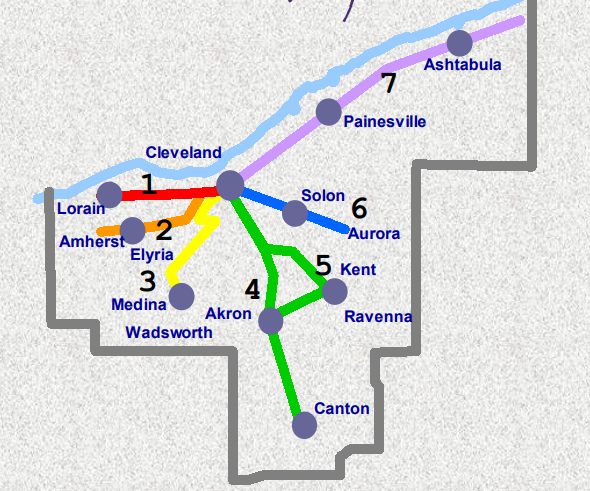
Revisiting the 2001 Northeast Ohio Commuter Rail Study
In December of 2001, the Cleveland-based consulting firms of Parsons Brinckerhoff and Urban Conservation and Design published the Northeast Ohio Commuter Rail Feasibility Study (dubbed NEORail), which was commissioned for NOACA (Northeast Ohio Areawide Coordinating Agency). In this study, seven different lines were surveyed to connect the Cleveland-Akron-Canton area via rail: Cleveland-to-Lorain, Cleveland-to-Amherst, Cleveland-to-Medina, Cleveland-Akron-Canton (via Hudson), Cleveland Akron Canton (via Kent), Cleveland-to-Aurora, and Cleveland-to-Ashtabula. Using freight railroads, and some rails owned by the Akron Metro RTA, it is possible to connect all of these communities through a passenger rail system without building an extensive amount of tracks.
While all of these routes would be transformative to adjacent cities and regions, our article will focus around Route 7, dubbed the “Lake East Corridor“. Route 7 would Cleveland and Ashtabula via Lake County, which connects most of Lake County’s population centers such as Mentor, Painesville, and Willoughby, to name a few.
When looking at the old NOACA Feasibility Study, they opted to center a Northeast Ohio regional rail network around a new multimodal hub near where the current Browns’ stadium resides (although not for much longer). However, we believe that there is a better option for a central rail station in Cleveland, at a similar cost: Tower City Center. While Tower City is already considered to be the regional passenger rail hub, with it being the only Downtown station in the RTA rail system, activating its Union Terminal roots could prove to be a worthwhile investment for the businesses that reside in, or around, the mammoth structure. Tower City and the connecting infrastructure, compared to a lakefront multimodal hub, provides better access to two of Northeast Ohio’s largest employment centers: The Downtown Business District & University Circle.
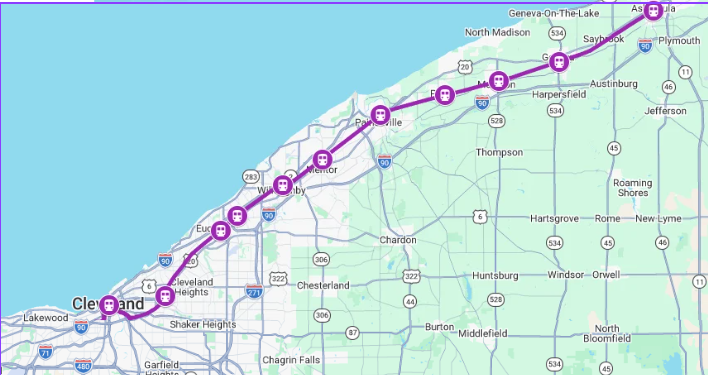
Possible Stop Configuration (Left-to-Right on Map)
Downtown Cleveland (Tower City Center)
University Circle
Euclid
Wickliffe
Willoughby
Mentor (Great Lakes Mall)
Mentor (Center St.)
Painesville
Perry
Madison
Geneva
Ashtabula
What Would Service Look Like?
With the entirety of the route being double-tracked, the frequency of trains is only limited to the freight traffic that would share the same tracks with this proposed regional rail route. Lake County for Public Transit proposes a schedule that gives 30-to-40 minute headways during peak commuting times, with bi-hourly service on off-peak times during weekdays. This gives the route more of a commuter rail operational feel, as this does focus on the 9-to-5 worker. However, it differs in the sense that service does not pause during off-peak schedules, and the directions of the trains would not run unidirectional depending on the morning/evening commute peak.

On weekends, we believe that a consistent hourly service that runs through the night would promote those commuting downtown for events to take the train, while also serving the nightlife crowd. This train connects with RTA routes that serve Ohio City and The Flats, while also being within walking distance from East 4th, and other popular downtown places. In the other direction, the train would serve Downtown Willoughby, which is lined with bars and popular restaurants, while also promoting the area to further grow and develop with transit-oriented development, as is the case with the other cities that line this route. Building transit to serve the nightlife crowd would cut down on DUIs and other alcohol-related driving incidents, as more people from a wider array of areas can take this transit line, and rideshare services would have to compete with transit’s ease of access and cheap prices.
Why Lake County Should Support this Proposal
Lake County has a booming population of healthcare workers, with a lot of them working in the booming University Circle neighborhood. Regional rail is the perfect solution to better connect Lake County and the employment center. Currently, in order to get to Little Italy/University Circle, citizens of Lake County must hop on I-90/Route 2, and then exit to Eddy Road or MLK Jr. Drive, both of which can be a hassle to navigate for their own reasons. The issue of parking also presents itself once at the destination. Parking is costly for both visitors and workers alike, no matter what “monthly pass“ a garage tries to sell. For the current public transit configuration, Laketran recently launched Route 13, which connects Painesville, Mentor, Wickliffe, and University Circle. However, it runs at unfavorable hours, especially for the majority of healthcare workers. A Regional Rail line would aim to cut transportation costs, promote easier access, and work for all commuters to the area, not just the 9-to-5ers.
These same dilemmas, and their unified solution, can be applied to downtown Cleveland, as well. Downtown Cleveland has been searching for new developments to bring people downtown again, especially on weekends. So, why not support and build a rail line that connects a populous suburban area directly to downtown? With Tower City being the downtown terminus, a Lake County resident would be within a short walking distance of Rocket Arena, Progressive Field, East 4th district, the JACK Casino, and many more places. On top of that, a transfer to the RTA Rapid would connect to the current AND new Browns Stadium, Cleveland Hopkins International Airport, the Rock Hall, Ohio City, and the Flats, to name a few. Connecting Lake County to the central business and transportation hub of the area would improve mobility for everyone who resides in this great region.
On top of the benefits of mobility that come with building this piece of transit infrastructure, one of the less-implied effects of building transit is that of the economic and development benefits. Transit promotes the formation of dense, mixed-use development that works for the people by being walkable and transit-accessible. Lake County, currently, is filled with examples of decaying towns, and car dependency is a factor that has contributed to these places becoming a shell of their former selves.
For example, Painesville’s downtown is filled with vacant parking lots, with new developments being spaced apart from each other due to parking minimums and no focus on transit-oriented development. The same can be said about Mentor, albeit there’s not really a true “downtown“ where they can focus their developments around. A rail station, or two, could fix that for the City of Mentor. Instead of allocating tax dollars to the widening of roads with little-to-no pedestrian safety measures, and allocating tax dollars to the annual paving of roads at the most inconvenient times, city planners all around Lake County should be focused on forming a cohesive downtown neighborhood, like it once was. And, what perfect way to supplement these developments with a regional rail line?
Transit works for the people. Transit works for the small business. Transit works for the workers. Transit works for the tourists. Transit works for everyone. What better place to grow transit and walkable infrastructure than in Lake County, Ohio? We have the perfect bones to implement these sustainable ideas, with downtowns being aligned with a railroad, so why not build toward the future?
